Showing posts with label Mammels. Show all posts

Mammals of Sri Lanka-Sambar Deer


Sri Lankan Sambar Deer

Rusa unicolor unicolor
ගෝනා, ගෝන මුවා
Sri Lankan Sambar Deer (Rusa unicolor unicolor) is a sub-species of Sambar Deer that lives in Sri Lanka. This subspecies is one of the largest Sambar Deer species with the largest antlers both in size and in body proportions. Large males weight up to 270-280 kg. Sri Lankan Sambar occurs in lowland dry forest, montane forest. Large herds of Sambar Deer roam the Horton Plains National Park, where it is the most common large mammal.
Habitat: Dry forest, mountain forest and grasslandsDistribution: Low country dry zone, UpcountryStatus: Common 

Mammals of Sri Lanka-Spotted deer


Spotted deer

Axis axisCheetal, තිත් මුවා,                                                                                              Axis deer, Chital, Chital deerThe Spotted deer is a deer which commonly inhabits wooded regions of Sri Lanka, Nepal, Bangladesh, Bhutan, India, and in small numbers in Pakistan. The Spotted deer is called Thith Muwa in Sinhalese. It is the most common deer species in forests of Sri Lanka.
The Spotted deer's coat is reddish fawn, marked with white spots, and its underparts are white. Its antlers, which it sheds annually, are usually three-pronged and curve in a lyre shape and may extend to 75 cm (2.5 ft). Compared to the hog deer, its close relative, the Spotted deer has a more cursorial build, its antler pedicles are proportionally short and its auditory bullae is smaller. It also has large nasals. It stands about 90 cm (3 ft) tall at the shoulder and masses about 85 kg (187 lb), although males tend to be larger than females. Its lifespan is around 20–30 years.
Sri Lankan axis deer are active primarily during early morning and again during the evening, but they are commonly observed near waterholes anytime. The Sri Lankan axis deer eats primarily grasses, but it also eats fallen fruits and leaves. The Sri Lankan axis deer graze closely with langur, peacock, wild buffalo, and sambar. They usually lives in groups of between 10-60 animals, though herds may include up to 100 animal.
 Habitat: Forests and Grass land.Distribution: Low country dry forests, savannas, and shrub lands. Very rarely, these deer inhabit dry mountain areas.Status: Common 

Mammals of Sri Lanka- Blue whale


Blue whale


Balaenoptera musculus
නිල් තල්මසා
The blue whale (Balaenoptera musculus) is a marine mammal belonging to the suborder of baleen whales (called Mysticeti). At perhaps over 33 metres (108 ft) in length and 180 metric tons or more in weight, it is the largest animal ever known to have existed. Long and slender, the blue whale's body can be various shades of bluish-grey dorsally and somewhat lighter underneath.As with other baleen whales, its diet consists almost exclusively of small crustaceans known as krill.
Blue whale has a long tapering body that appears stretched in comparison with the stockier build of other whales. The head is flat and U-shaped and has a prominent ridge running from the blowhole to the top of the upper lip. The front part of the mouth is thick with baleen plates; around 300 plates (each around one metre (3.2 ft) long) hang from the upper jaw, running 0.5 m (1.6 ft) back into the mouth. Between 60 and 90 grooves (called ventral pleats) run along the throat parallel to the body length. These pleats assist with evacuating water from the mouth after lunge feeding (see feeding below).
The dorsal fin is small, visible only briefly during the dive sequence. Located around three-quarters of the way along the length of the body, it varies in shape from one individual to another; some only have a barely perceptible lump, but others may have prominent and falcate (sickle-shaped) dorsals. When surfacing to breathe, the blue whale raises its shoulder and blowhole out of the water to a greater extent than other large whales, such as the fin or sei whales. Observers can use this trait to differentiate between species at sea. Some blue whales in the North Atlantic and North Pacific raise their tail fluke when diving. When breathing, the whale emits a spectacular vertical single-column spout up to 12 metres (39 ft), typically 9 metres (30 ft). Its lung capacity is 5,000 litres (1320 U.S. gallons). Blue whales have twin blowholes shielded by a large splashguard.

The flippers are 3–4 metres (9.8–13 ft) long. The upper sides are grey with a thin white border; the lower sides are white. The head and tail fluke are generally uniformly grey. The whale's upper parts, and sometimes the flippers, are usually mottled. The degree of mottling varies substantially from individual to individual. Some may have a uniform slate-grey color, but others demonstrate a considerable variation of dark blues, greys and blacks, all tightly mottled.
Blue whales can reach speeds of 50 kilometres per hour (31 mph) over short bursts, usually when interacting with other whales, but 20 kilometres per hour (12 mph) is a more typical traveling speed. When feeding, they slow down to 5 kilometres per hour (3.1 mph). Blue whales most commonly live alone or with one other individual. It is not known how long traveling pairs stay together. In locations where there is a high concentration of food, as many as 50 blue whales have been seen scattered over a small area. However, they do not form the large, close-knit groups seen in other baleen species.
Blue whales were abundant in nearly all the oceans on Earth until the beginning of the twentieth century. For over a century, they were hunted almost to extinction by whalers until protected by the international community in 1966. A 2002 report estimated there were 5,000 to 12,000 blue whales worldwide.
Blue whales are rorquals (family Balaenopteridae), a family that includes the humpback whale, the fin whale, Bryde's whale, the sei whale and the minke whale. The family Balaenopteridae is believed to have diverged from the other families of the suborder Mysticeti as long ago as the middle Oligocene. However, it is not known when the members of those families diverged from each other.
Habitat: Deep SeaDistribution: Around the world, mainly can be seen in Mirissa and Trinco. Mirissa is one of the hot spots for Blue Whale watching in the world.Status: Endangered 

mammals of sri-lanka- grey angur


Grey Angur


Grey langurSemnopithecus priam
Hanuman langur, 
               Gray langurs are the most widespread langurs of South Asia, are a group of Old World monkeys constituting the entirety of the genus Semnopithecus as traditionally defined, though genetic evidence suggests at least the Nilgiri and Purple-faced Langurs also belong in this genus.
Gray langurs are large and fairly terrestrial, inhabiting forest, open lightly wooded habitats, and urban areas. Most of them are found at low to moderate altitudes. Commonly seen close to archiological sites in low country dry zone together with groups of Sri Lanka toque monkey.
These langurs are largely gray (some more yellowish), with a black face and ears. Externally the various species mainly differ in the darkness of the hands and feet, the overall color and the presence or absence of a crest. There are also significant variations in the size depending on the species, but disregarding the tail males are typically up to 75 centimetres (30 in) long and females 65 centimetres (26 in). Their tail is always longer than their body.
Habitat: ForestDistribution: Common in low country dry zoneStatus: Common 

Animals in sri lankaLeopard


Leopard hiding behind brush


At about 5pm, just an hour before sunset, we were rewarded with a sighting of a Sri LankanLeopard Pantera pardus kotika in Yala National Park.  With only about 35 leopards here, it was quite thrilling!  We first saw him (or her) in the bushes by the side of the road where another 4WD vehicle had stopped.  We tried to get a photo, but couldn't.  The leopard began walking west through the bush, and then, before the other vehicles moved, our driver backed up and took a side track hoping to intersect the leopard on its path.  He was right on!  We watched as this beautiful animal hid in the bushes (left), keeping us in view, then ambled across the dirt road to the edge of a pond.  Spotting a water buffalo ahead, it put on a burst of speed (photo right), but didn't pursue for long.  Instead, it decided to climb a huge tree and drape itself over the branches, four legs and long tail swinging freely.  Then, with a bit of hesitation but skill it descended the tree head first and walked sedately back into the brush.  Fantastic! We had over a half an hour of leopard watching!  Sri Lanka's leopards are endemic to the island and are listed by the World Conservation Union as threatened.

Sri Lanka Animals-Elephant


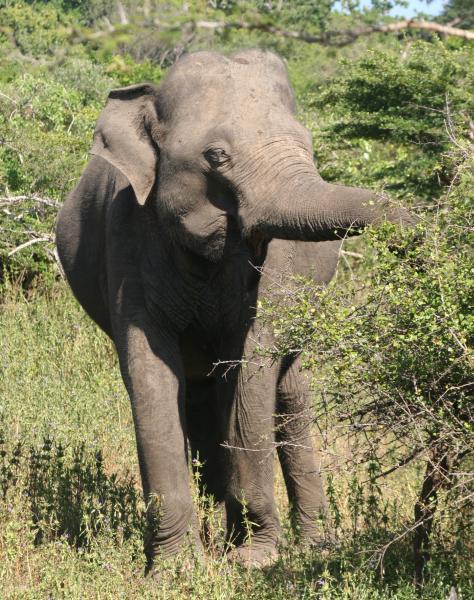
Elephant Feeding in Yala National ParkLargest, and perhaps best known of the Sri Lankan wildlife is the Asian Elephant Elephus maximus.  The Asian elephant differs from its cousin, the African elephant, in several ways: the Asian is smaller, with shorter ears, a single (not double) "finger" at the end of the trunk, a more rounded back, and 4 nails, instead of 3, on its hind feet.  It also has a personality that allows it to be domesticated.  That is not to say that when a wild elephant chooses to cross your path in a park you don't get out of its way -- you do!  Even in a big vehicle!  Sir Lankan elephants don't carry a lot of ivory: most females and many of the males have no tusks at all. Asian elephants live in groups of about 10 animals led by older female.  Young males are banished from the group to fend for themselves, although they often form small bachelor herds.
Their are 2 subspecies in the country: Elephus maximus maximus (the Ceylon elephant) and Elephus maximus vilaliya (the Ceylon marsh elephant) and both are listed as endangered.  It is estimated that there are perhaps 2500 wild elephants in the country now, as opposed to over 12,000 in 1900.  Most live in 7 of the 10 major national parks.  Wild elephants that venture into farmlands can sometimes be transported to the parks to live.

Mammels of sri lanka


Mammels

Sri Lankan Elephant is the largest mammal in Sri Lankan animal world. It belongs to Asian Elephant Type. The Asian Elephants are differ from the African Elephant


The Asian elephant is smaller than the African and its ears also short. There only one finger at the end of the trunk instead of two. But there are four round nails to the Sri Lankan elephant but Africans has only three.

Sri Lankan elephant has a personality that allows it to be domesticated. But it not means all the elephants. Wild elephants are more dangerous to the villages. They destroy all the cultivations and houses belonging to poor villages. Some time there are clash between elephants and people. As a result of that elephant had been killed and disappeared. Then people also had been killed by the wild elephants.


Tusk is the very valuable part of the elephant. It called as Ivory. Most female elephants and many of the male elephants have no tusk at all. Most of wild elephants live in group. There are is a leader to that group. It is depend on the power of the elephant. Mostly the leader of that group may be an oldest female elephant. So young males have been banished from their group and they make their own small herds and live together.

How ever Ceylon elephant listed as an endangered animal. There are more than 12,000 elephants in 1900 but now we have only about 2500. They are live in major national parks. 

Those who injured or abandoned cached by warden of wild life and treated in elephant orphanage and transported to the parks to live.

Ceylon subspecies are listed by the World Conservation Union as threatened.


Other than that we can see most of the traditional and religious ceremony domesticated elephants are in use. Normally they had been dressed and the mahout is always with the goad. Especially in the Kandy Asela Perahera we can see lot of domesticated elephants participating. In the perehara elephants are indicated the clouds of the sky. It is the symbol of the Ceylon royalty.